Black history and life as seen through Savannah’s newspapers
Vol. I · 1763–1968
Because sometimes the most revealing history isn’t hidden at all. It was printed in the newspaper.
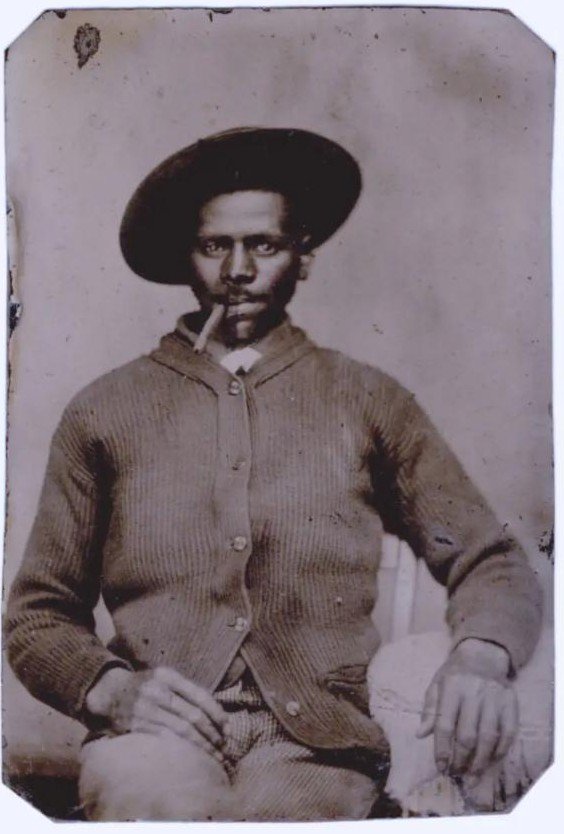
Source: Unidentified man with cigar, tintype, about 1870. Courtesy of James E. Arsenault & Company (https://www.jamesarsenault.com/pages/books/5992/tintype-portrait-of-an-african-american-man-smoking-a-cigar).
1849
EditorialsJune 6, 1849 · Savannah Daily Republican177 years ago
No Cigar Puffing for Negroes. They Have Too Many Indulgences Already.
“The coloured gentry of this city have, in our opinion, quite too many indulgences already.”
A Black man puffing a cigar on a Savannah street in 1849 brought a complaint to the newspaper, and the editor demanded the city’s smoking ban be enforced.
Narration0:00
On a Saturday evening in early June 1849, a “very respectable citizen” saw a Black man walking in a Savannah street, “puffing the smoke of his cigar into the face of a lady whom he met.” He took his complaint to the Savannah Daily Republican and asked the paper to call the authorities’ attention to “this nuisance.”
“With this request we cheerfully comply,” the editor wrote on Wednesday, June 6, under the heading “High Life Below Stairs.”
“There certainly is an ordinance strictly prohibiting this class of people from smoking in the streets,” he wrote, and it had “at times been enforced with proper severity.” But from “the frequent instances of its violation,” he was “persuaded that but little attention has been paid to it for some time past.”
He wanted that changed. “We hope that our authorities will take the thing vigorously in hand, and relieve the public at once from the annoyance.”
Then he gave his reasons. “The coloured gentry of this city have, in our opinion, quite too many indulgences already.” Fire was another. There was “risk enough of fires from white people smoking in the streets,” he wrote, “without multiplying it by allowing the same privilege to the blacks.”
He added a complaint of his own. “For one, we decidedly object to leaving the pavement in order to avoid the fumes of bad tobacco ejected from the mustached lips of these self-conceited dandies.”
The column did not stop at cigars. It went on to clothing and household servants. Near the end, the editor counted “at least five hundred people in this city” who led lives “quite unprofitable to their masters and mistresses,” and wrote that “a large class” would be better off “sold to work on the plantations remote from cities.”
His last line: “Something must be done for these people, or our pavements must be widened for their special accommodation.”
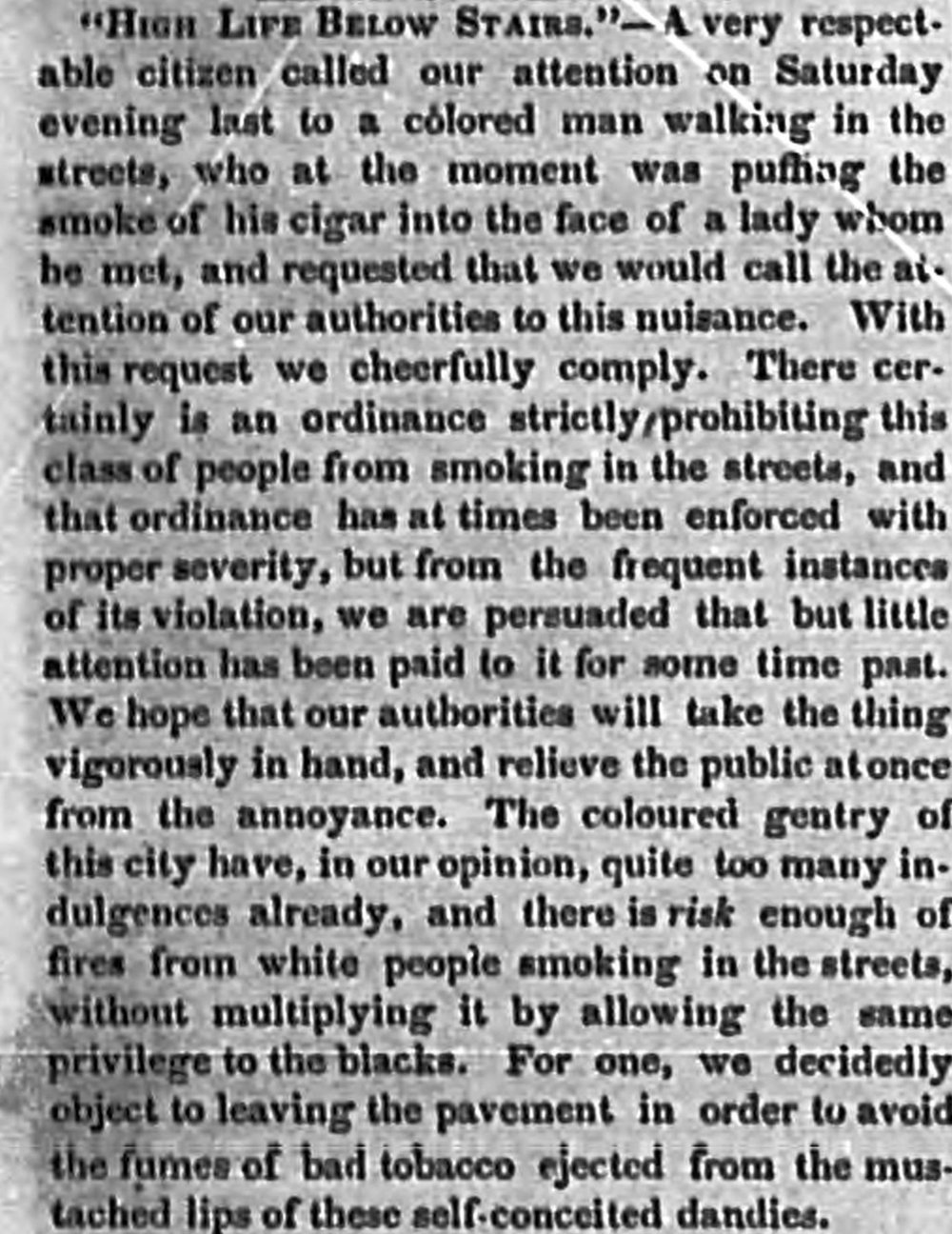
As printed
“High Life Below Stairs” (smoking passage). Savannah Daily Republican, June 6, 1849, p. 2, column 1. Georgia Historic Newspapers, Digital Library of Georgia.Read the article
“HIGH LIFE BELOW STAIRS.”—A very respectable citizen called our attention on Saturday evening last to a colored man walking in the streets, who at the moment was puffing the smoke of his cigar into the face of a lady whom he met, and requested that we would call the attention of our authorities to this nuisance. With this request we cheerfully comply. There certainly is an ordinance strictly prohibiting this class of people from smoking in the streets, and that ordinance has at times been enforced with proper severity, but from the frequent instances of its violation, we are persuaded that but little attention has been paid to it for some time past. We hope that our authorities will take the thing vigorously in hand, and relieve the public at once from the annoyance. The coloured gentry of this city have, in our opinion, quite too many indulgences already, and there is risk enough of fires from white people smoking in the streets, without multiplying it by allowing the same privilege to the blacks. For one, we decidedly object to leaving the pavement in order to avoid the fumes of bad tobacco ejected from the mustached lips of these self-conceited dandies.
[…] Near the end of the column: “There is a large class whose best interests, so far as contented industry, good morals, and permanent happiness are concerned, would be consulted, by being sold to work on the plantations remote from cities, and from the allurements of a prurient and ambitious fashion. We must have sumptuary laws. Something must be done for these people, or our pavements must be widened for their special accommodation.”
Terms on this page
Ordinance:
a city law.
Gentry:
people of good social standing; the editor’s word.
Pavement:
the sidewalk.
Dandies:
men who pay close attention to fashionable dress and appearance.
Mustached:
wearing a mustache.
Sumptuary laws:
laws limiting what people may wear or buy.
Source
Savannah Daily Republican, Wednesday, June 6, 1849, page 2, column 1 (Georgia Historic Newspapers, Digital Library of Georgia): “High Life Below Stairs,” smoking passage.